
The minutes after an expected death in a care facility are quiet, and they are also procedural. Staff have a family to support, a chart to complete, a physician to reach, and — eventually — a transport crew to admit. Doing all four well at once is a skill, and it is one that is rarely taught directly.
This guide walks through how after-death transfers in Florida typically work in hospice, skilled nursing and assisted living settings, what the law requires, and how to make the transfer itself as calm as the rest of the care that preceded it.
This is general information for care staff and families, not legal advice. Your facility’s own policies and your medical director’s standing orders always govern.
Step one: pronouncement
Florida law does not squarely answer the question of who may pronounce death, and staff should follow their own facility’s policy and their medical director’s standing orders rather than any general guidance — including this article.
What Florida law does address is who certifies the death. Under § 382.008, Fla. Stat., the certificate of death is completed by the attending physician, physician assistant or advanced practice registered nurse — including an APRN providing hospice care under physician protocol — or, in medical examiner cases, by the district medical examiner. In practice, a hospice or facility nurse typically confirms and documents the death at the bedside and notifies the certifying practitioner, who completes the certification.
The practical point for transport: remains are not released until the death has been pronounced and documented according to your facility’s policy. A transport company arriving before that is complete will wait, and should.
Step two: is this a medical examiner case?
This determination drives everything that follows, and it has two separate parts that are easy to conflate.
Jurisdiction. Under § 406.11, Fla. Stat., the district medical examiner determines the cause of death in listed categories — among them deaths by accident, by criminal violence, by suicide, by poison, suddenly when in apparent good health, in suspicious or unusual circumstances, and deaths unattended by a practicing physician. Where the medical examiner takes a case, the remains cannot be released to a funeral home or transport service until that office authorizes it, and the ME’s office directs where the remains go and when. Facility staff should notify the medical examiner’s office promptly when a death falls into a reportable category, and should not permit a transfer before release is granted.
Cremation review. Separately, the same statute directs the medical examiner to determine cause of death when a body is to be cremated, dissected or buried at sea. This is a cause-of-death determination, not a custodial hold — the medical examiner does not take custody of every cremation case — but it is a step in the timeline. Expect a cremation approval even after an entirely unremarkable, expected death, and build it into what you tell families about timing.
Step three: notifications, in order
A workable sequence for most facilities:
- The family, if not present — with a person, not a voicemail, wherever possible.
- The attending or certifying physician, to begin the death certificate process.
- The medical examiner’s office, if the death is reportable or cremation is planned.
- The organ and tissue procurement organization, where required by facility policy or federal conditions of participation. This call is time-sensitive and is easy to miss in the moment.
- The funeral home of record — and here is the most common friction point.
Step four: identify the funeral home before you call transport
Nothing delays a transfer more reliably than an unknown funeral home. If a family has no arrangement in place, the transfer cannot begin, because a licensed removal service takes custody on behalf of a funeral establishment — § 497.385, Fla. Stat. expressly bars removal services from entering into removal or refrigeration contracts with the general public.
For hospice programs especially, capturing the funeral home of choice during admission — and updating it — removes the single largest cause of a four-hour wait with a body in a resident room and a family in the hallway.
Step five: preparing the room and the family
Small things matter here, and staff who do them well are remembered for years:
- Ask the family whether they want to be present during the transfer, or prefer to step out. Both answers are normal. Do not decide for them.
- Offer time. Families often need twenty minutes more than they will ask for.
- Remove medical equipment where policy permits, and tidy the room.
- Note the location of personal effects, jewelry and dentures, and document what stays with the resident and what is returned to family. Jewelry left on a decedent should be documented in writing, with a witness.
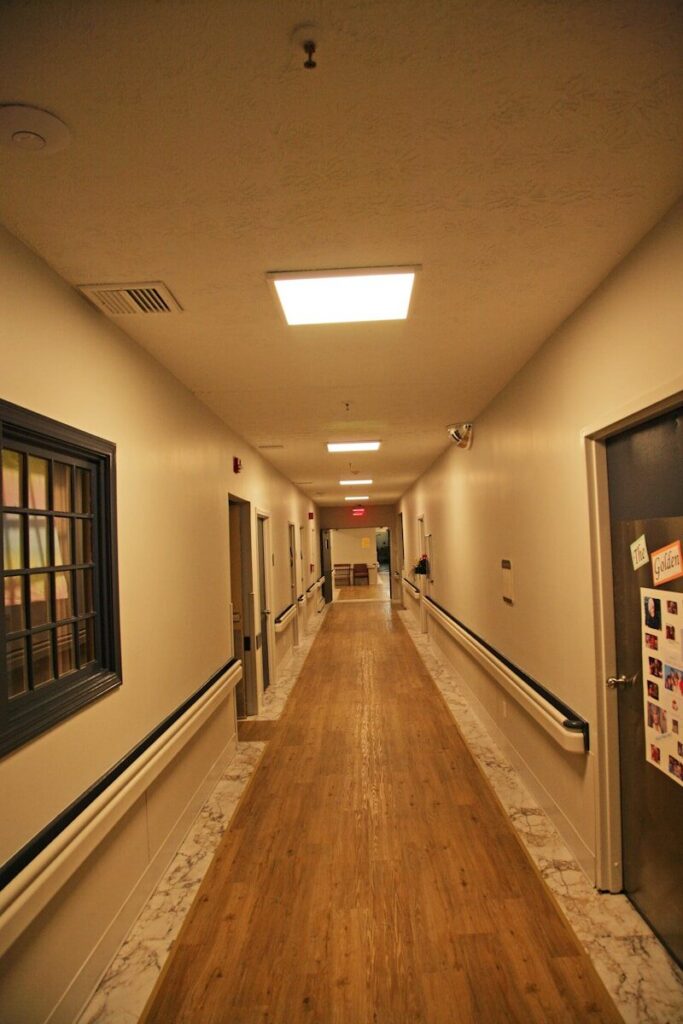
- Clear the route: know which door, which elevator, whether a key or badge is needed, and whether a supervisor must escort.
- If the transfer will pass through common areas, consider timing and whether other residents are present. Many facilities have a quiet practice for this; if yours does not, it is worth creating one.
Step six: the transfer itself
A professional transport crew should arrive in a clean vehicle appropriate to the setting — an unmarked vehicle is standard practice for assisted living and residential calls — with uniformed technicians who identify themselves at the desk and take direction from staff.
Florida law sets the floor for how remains must be handled in transit: they must be completely covered and treated with dignity at all times, and placed in a container adequate to prevent seepage of fluids and escape of odors (§ 497.386, Fla. Stat.). Expect chain-of-custody paperwork to be signed by facility staff and the technician, identifying the decedent, the receiving funeral home, the time of release and the personnel involved.
If the crew behaves in a way that would embarrass your facility in front of a family, tell the funeral home. They will want to know.
The 24-hour rule facilities should understand
Florida Statute § 497.386 provides that a dead human body may not be held in any place or in transit over 24 hours after death or pending final disposition unless it is maintained under refrigeration at 40°F or below, or is embalmed or otherwise preserved in a manner approved by the licensing authority.
The same statute also restricts where remains may be stored at all: licensed funeral or direct disposal establishments, health care facilities, medical examiner facilities, morgues, and cemetery holding facilities. For an assisted living facility in particular, that location restriction is often the more relevant half of the rule.
These provisions carry real penalties. Violating the 24-hour preservation requirement or the handling-and-dignity standards of § 497.386 is a third-degree felony; violating the storage-location and container requirements is a first-degree misdemeanor.
Most facilities do not have compliant refrigeration. Practically, this means transfer to a funeral home, crematory or medical examiner facility should not be left to drift. When a family is undecided about arrangements, the clock is still running — which is another reason to identify the funeral home early.
What good response times look like
There is no statutory response standard, and honest answers vary by geography and hour. What a facility should expect is a known standard: a transport partner who tells you what their response window is for your county, answers the phone with a live dispatcher, and calls you if they will be late.
If your facility is regularly waiting three or four hours for a transfer, that is worth raising with your funeral home partners directly. It is usually fixable.
Common delays, and how to prevent them
| Delay | Prevention |
|---|---|
| Funeral home not identified | Capture funeral home of choice at admission; review periodically |
| Pronouncement not yet documented | Confirm standing orders and who may pronounce, per shift |
| Medical examiner release pending | Notify the ME’s office early; know which deaths are reportable |
| Access problems after hours | Provide the transport company the correct entrance, gate code and contact in advance |
| Family not ready | Ask what they want, offer time, and communicate the plan to the transport crew |
How Bay to Bay works with Florida care facilities
Bay to Bay Mortuary Transport has served Florida hospices, hospitals, nursing homes and funeral homes since 1985. We dispatch statewide, 24 hours a day, with unmarked vehicle options for residential and assisted living settings and uniformed, background-checked technicians trained in the discretion these environments require.
We are happy to provide facility staff with a one-page transfer checklist and a direct dispatch number to post at the nurses’ station. Get in touch or call 727-542-4321. Funeral homes and crematories can learn about partnering with us here.
Frequently asked questions
How long can a body remain in a nursing home or hospice room after death? Florida law requires that remains not be held over 24 hours after death or pending final disposition unless refrigerated at 40°F or below, embalmed, or otherwise preserved in a manner approved by the licensing authority (§ 497.386, Fla. Stat.). The same statute also limits where remains may be stored. Most facilities transfer well within that window, and facility policy is often stricter.
Can a family be present when the body is removed? Yes, and many families choose to be. Others prefer to step out. Ask rather than assume, and give the family time to decide.
Who calls the mortuary transport service — the facility or the funeral home? Usually the funeral home dispatches transport, because the removal service takes custody on the funeral establishment’s behalf. Facilities notify the funeral home of record; some facilities with standing arrangements call transport directly.
Does the medical examiner have to approve a cremation in Florida? Florida law directs the medical examiner to determine cause of death when a body is to be cremated (§ 406.11, Fla. Stat.), so a cremation review step is part of the process even in expected deaths. That is a cause-of-death determination rather than a custodial hold. Florida also makes it unlawful to cremate before 48 hours have passed since death (§ 872.03, Fla. Stat.), a prohibition with no statutory exceptions.